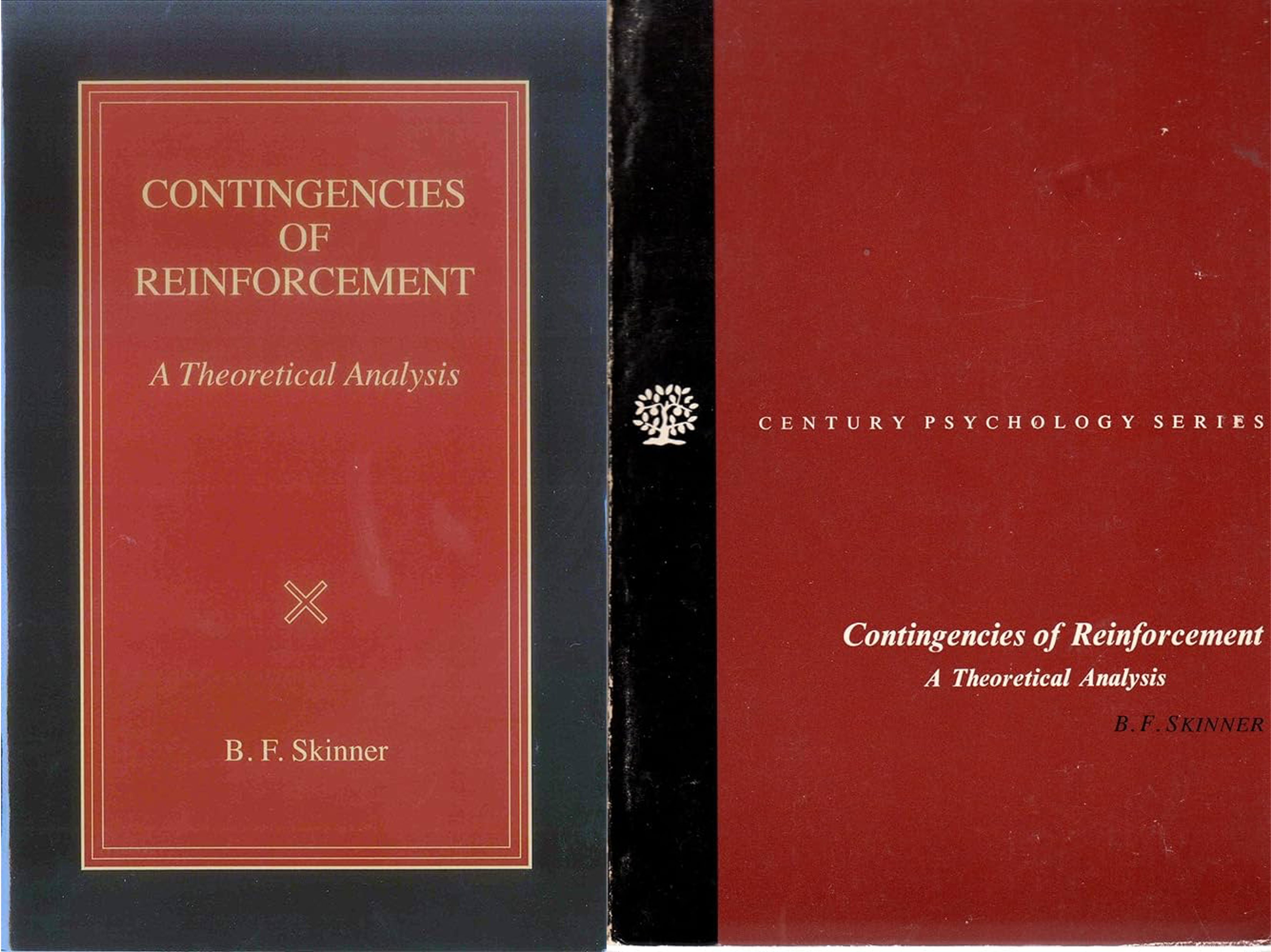
Contingencies of Reinforcement A Theoretical Analysis - B. F. Skinner
추천글 : 【서적】 책 추천
1. 주요 용어 [본문]
2. 주요 내용 [본문]
3. 지식에 관하여 주목할 만한 문장 [본문]
1. 주요 용어 [목차]
○ contingency, topography, operant, phylogeny, ontogeny, reinforcer, aversive, discriminative, punish, repertoire
2. 주요 내용 [목차]
○ 인용 자료가 굉장히 광범위함 : 철학, 윤리, 과학, 심리, 문학, 언어, 법, 경제, 역사, 종교
○ 긍정 자극과 부정 자극(cf. 심리적 터모일)이 행동을 유발하는 메커니즘을 서술함 : 저자는 긍정 자극을 더 강조함
○ 유전적 요인(phylogeny)과 환경적 요인(ontogeny)에 대해서도 자세히 분석함
3. 지식에 관하여 주목할 만한 문장 [목차]
Problem solving is often said to produce knowledge. An operant formulation permits us to distinguish between some of the things to which this term has been applied.
What is knowledge, where is it, and what is it about? Michael Polanyi and P.W. Bridgman have raised these questions with respect to the apparent discrepancy between scientific facts, laws, and theories (as published, for example, in papers, texts, tables of constants, and encyclopedias) and the personal knowledge of the scientist. Objective knowledge transcends the individual; it is more stable and durable than private experience, but it lacks color and personal involvement. The presence or absence of "consciousness" can scarcely be the important difference, for scientists are as "conscious" of laws as they are of the things laws describe. Sensory contact with the external world may be the beginning of knowledge, but contact is not enough. It is not even enough for "conscious experience," since stimuli are only part of the contingencies of reinforcement under which an organism distinguishes among the aspects and properties of the environment in which it lives. Responses must be made and reinforced before anything can be seen.
The mistake is to suppose that only one of these kinds of behavior represents knowledge. Polanyi argues that "tacit knowing is ... the dominant principle of all knowledge, and ... its rejection would therefore automatically involve the rejection of any knowledge whatever." It is true that an apprentice blacksmith may not know why he is operating the bellows as he does―he may have no "feel" for the effect on the fire―but the rule, together with its effect on his behavior, is still a "form of knowledge."
입력: 2025.07.20 01:15
'▶ 인문과학 > ▷ 문학·비문학' 카테고리의 다른 글
| 【소설】 추리소설 `이데아 글리치`를 펴내며 (0) | 2025.08.16 |
|---|---|
| 【소설】 태평양 쓰레기 섬을 해결하려면? - `운석 사냥꾼 진유하 아쿠아 행성편`을 펴내며 (0) | 2024.04.03 |
| 【문학·비문학】 문학·비문학 목차 (0) | 2023.03.01 |
| 【비문학】 2강. 설명문 (0) | 2023.03.01 |
| 【비문학】 1강. 논설문 (0) | 2023.03.01 |


최근댓글